6 steps to jump-start retirement savings
Share:

September 23, 2026
Explore ways to help ensure that you'll have the income you need for your future.
Most people have good intentions when it comes to investing for retirement. But with immediate financial needs like mortgage or rent payments, student loans, credit card debt and everyday expenses claiming a share of your paycheck, it's easy to let planning for the future fall behind on your list of financial priorities. "When you're younger, the temptation is to defer retirement savings because you won't need the money for another several decades," says Christopher Vale, senior vice president, Consumer Investments, Bank of America. "But by getting started now, you'll make it a lot easier to get to whatever goal you choose for when you retire."
Here are six steps you can take to help you prepare for your future.
Tap + to learn more
Step 1: Treat your retirement savings as a monthly expense
"Take that money off the top of your income, not from what's left at the end of the month," suggests Vale. "You've probably heard this advice before, but it's a strategy that really works." Next, look at your budget to identify areas where you can free up more money to save. Seemingly small savings — like finding a better deal on your cable or cellphone service — can really add up.
If you invested an extra $50 a week
Imagine taking the money you spend on little splurges — a few takeout lunches or a couple cups of coffee — and investing it in your retirement account. As shown below, a bit of sacrifice and reinvestment could potentially really add up over time.*
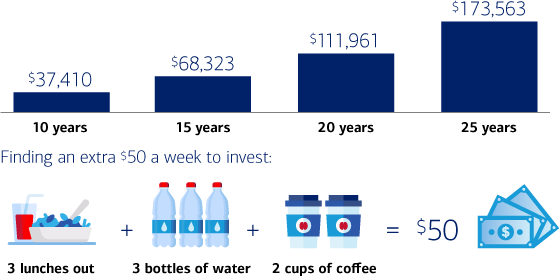 Finding an extra $50 a week to invest could yield $37,410 in 10 years, $68,323 in 15 years, $111,961 in 20 years and $173,563 in 25 years. You can find an extra $50 per week by using the money saved on three lunches out, three bottles of water and two cups of coffee.
*Assumes weekly contributions at an annual rate of return of 6.9%. Prices for goods assume $4.00/cup of brewed coffee, $12.50/lunch eaten out and $1.50/bottle of water.
Source: Bank of America Chief Investment Office
Step 2: Get into the 401(k) routine
If you're not already enrolled, be sure to sign up for your employer's
401(k) plan as soon as you can to take advantage of the benefits it offers. Your contributions are automatically deducted from your paycheck, making it easier to maintain the discipline of contributing.
Traditional 401(k) contributions are made with pre-tax dollars and are subject to income tax when you withdraw them. In addition, some employers offer Roth 401(k) contributions, which can potentially be advantageous for younger investors. Although Roth 401(k) contributions are made with after-tax income, withdrawals during retirement won't be taxed at the federal level if taken as qualified distributions.Footnote 1 This may be especially beneficial if you expect your tax rate later in retirement to be higher than your current rate.
Your employer may even match a certain percentage of your 401(k) contributions. If that's the case,
try to contribute enough to earn the full match. "An employer match should be viewed as part of your total compensation, so don't leave that money on the table," says Vale.
Regardless of whether you have access to a 401(k), you may want to think about investing in a traditional or Roth IRA.
With a
Roth IRA, you can contribute after-tax dollars without paying federal tax on your earnings when you withdraw them at retirement if they're taken as a qualified
distribution.Footnote 2 Keep in mind that there can be restrictions to your ability to contribute to a Roth IRA based on your modified adjusted gross income (MAGI); see our
annual limits guide (PDF) for more information. Consult with your tax and/or legal advisor about possible state tax consequences related to Roth distributions.
In the case of a
traditional IRA, you may be eligible for a tax deduction now, and the distribution would be subject to income tax when you withdraw the assets later. This can potentially work to your advantage if you're currently in a tax bracket higher than the one you're expecting to occupy during your retirement, when you'll have to pay tax on withdrawals. Try our
Retirement Account Selector Tool to see which type of IRA might be right for you or ask a tax advisor for recommendations to help you decide.
Step 4: Build on your successes
Especially when you're starting out, contributing as much of your income as you can toward your retirement account(s) may make sense, considering that future healthcare costs and inflation could add up to more than you think. If you can't contribute much right now, stretch as far as you can and commit to increasing your contribution when you get a raise or pay off a large expense. Even raising it by 1% or 2% can add up. If your employer's 401(k) plan offers an automatic increase feature — which regularly increases your contribution rate over time — consider contributing an even higher percentage if you can.
Your contribution rate: A little extra can help make a big difference
How much you contribute to your retirement plan account today can make a big difference in how much you have when you're ready to retire. Just increasing your contribution rate from 4% to 6% could add nearly $100,000 to your nest egg over 30 years, assuming a $50,000 salary.
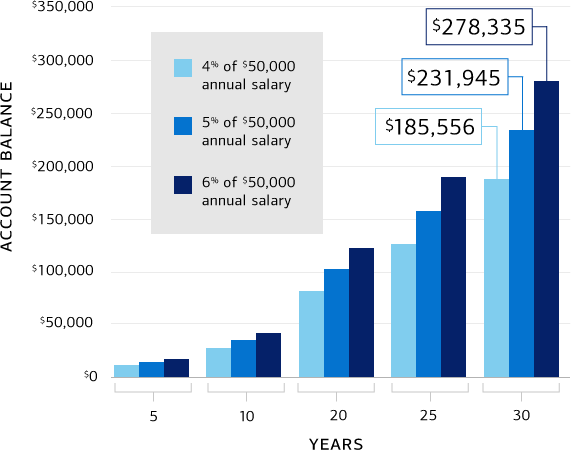 A person who earns $50,000 and invests for 30 years would have $185,556 if they invested 4% of their annual salary, $231,945 if they invested 5% of their annual salary and $278,335 if they invested 6% of their annual salary.
Note: Assumes a 6.9% return
Investing involves risks. There is always the potential of losing money when you invest in securities.
Source: Bank of America Chief Investment Office
Step 5: Consider keeping all your accounts under the same roof
It can be much easier to keep track of your retirement funds and monitor an overall asset allocation when all of your retirement accounts are in one place. If you've left retirement funds in previous employers' 401(k) plans, you have a
number of choices for what to do with those assets. You generally can leave them in your former employer's plan, move the assets to your current employer's plan, roll your assets to a traditional or Roth IRA (including conversion of pre-tax assets to a Roth IRA), or take a cash distribution.
Each choice may offer different investment options and services, fees and expenses, withdrawal options, required minimum distributions and tax treatment (particularly with reference to employer stock). They may also provide different protections from creditors and legal judgments. These are complex choices and should be considered with care. A financial professional can help you understand your options.
Step 6: Avoid taking early withdrawals for non-retirement-related expenses
Of course, investing for retirement isn't your only focus — you may also need to save for your child's college costs, pay down debts or put away money for emergencies.
By balancing retirement planning with those other needs, you can avoid dipping into your retirement accounts — something you really don't want to have to do.
Usually, if you're under age 59½ and withdraw retirement account funds, you'll have to pay taxes on any pre-tax assets you withdraw, including earnings on Roth contributions. On top of that, you may have to pay a 10% additional federal tax on the taxable amount of the distribution unless an exception applies.Footnote 3 Ask your tax advisor about the rules for using those funds for education, birth, adoption or the purchase of a home, and be aware of how withdrawing those funds can affect your future retirement income.
Once you've established a retirement savings strategy that also accounts for your other financial priorities, you're on your way. Stick to your plan and monitor it regularly to be sure it continues to align with your goals as they evolve. By the time you retire, you'll be glad you started investing as much as you did as early as you did.
Share:
Footnote 1 Any earnings on Roth 401(k) contributions can generally be withdrawn federal income tax-free if you meet the two requirements for a "qualified distribution": 1) At least five years must have elapsed from the first day of the year of your initial contribution or conversion, if earlier, and 2) You must have reached age 59½ or become disabled or deceased. If you take a non-qualified withdrawal of your Roth 401(k) contributions, any Roth 401(k) investment returns are subject to regular income taxes, plus a possible 10% additional federal tax if withdrawn before age 59½, unless an exception applies. State income tax laws vary; consult a tax professional to determine how your state treats Roth 401(k) distributions.
Footnote 2 Generally, for a distribution from a Roth IRA to be federal (and possibly state) income tax-free, it must be qualified. A qualified distribution from your Roth IRA may be made after a five-year waiting period has been satisfied (this period begins January 1 of the tax year of the first contribution or the year of conversion to any Roth IRA) and you (i) are age 59½ or older, (ii) are disabled, or (iii) qualify for a special purpose distribution, which is for the purchase of a first home (lifetime limit of $10,000). In situations where the original account owner is deceased, distributions to the beneficiary are also considered a qualified distribution. If you take a non-qualified distribution of your Roth IRA contributions, the earnings portion of such distribution generally will be subject to ordinary income tax, plus a possible 10% early withdrawal additional tax if received before age 59½, unless an exception applies. A 10% early withdrawal additional tax may also be owed on converted Roth IRA principal withdrawn before the end of the five-year period. Although RMDs are not required for the original account owner, RMDs would apply to the inherited Roth IRA account.
Footnote 3 Exceptions to this general rule include, but are not limited to, distributions for a first-time home purchase (applies to IRA, SEP and SIMPLE but not 401(k) plans; lifetime limit of $10,000), qualified higher education expenses, the account owner's death or disability, IRS levy,
Go to third-party website SEPPs popup, qualified birth or adoption distributions, certain disaster distributions, and certain medical expenses and may depend on the type of plan from which the distribution is taken. State income tax laws vary; consult a tax professional to determine how your state treats Roth 401(k) distributions and for more information on your personal circumstances.
Investing involves risk. There is always the potential of losing money when you invest in securities.
Merrill, its affiliates, and financial advisors do not provide legal, tax, or accounting advice. You should consult your legal and/or tax advisors before making any financial decisions.
MAP9116704-03232028