Market briefs
Share:

Breaking insights on the economy, market volatility, policy changes and geopolitical events
September 10, 2026
Pop the champagne — and rebalance with purpose
With the S&P 500 total return index up by double digits in 2026 as of early September,Footnote 1 following an approximately 18% total return in 2025,Footnote 2 investors have had much to smile about lately. But there's one reality that could elicit some frowns: the long-term capital gains taxes that would come due if you sell some of those high-performing stocks to rebalance your portfolio.
"With a top federal long-term capital gains tax rate of
20%,Footnote 3 — or potentially 23.8% for investors subject to the 3.8% Net Investment Income Tax —
capital gains taxes (PDF) may feel like a painful setback," says Joe Curtin, head of Portfolio Management for the Chief Investment Office (CIO), Merrill and Bank of America Private Bank. "But looked at another way, they are a sign you've succeeded as an investor." Meanwhile, holding onto appreciated assets simply to delay paying capital gains taxes poses risks of its own, Curtin notes. A portfolio may become overconcentrated and stray from your original strategy.
Bottom line: "While taxes should inform portfolio decisions, diversification, risk management and personal goals should be the primary drivers," he adds. His recent CIO Portfolio Insights report, "
Pop the Champagne (PDF)," offers a step-by-step approach to rebalancing with purpose.
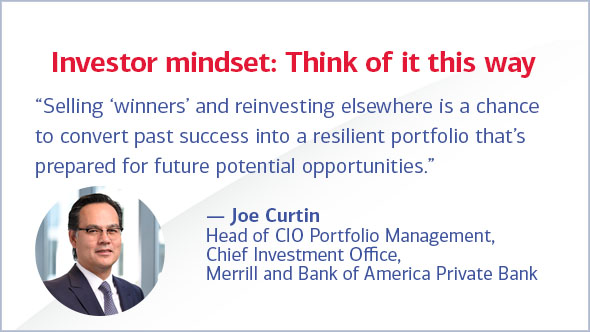 Investor mindset: Think of it this way. Selling winners and reinvesting elsewhere is a chance to convert past success into a resilient portfolio that's prepared for future potential opportunities. Joe Curtin, head of CIO Portfolio Management, Chief Investment Office, Merrill and Bank of America Private Bank
3 steps to rebalancing with purpose — and tax efficiency
- Celebrate the gain, compare your choices: "First, acknowledge your achievement," Curtin advises. "This could shift your mindset from 'How do we avoid taxes?' to 'How can we use this event to improve the portfolio?'" Next, a thorough review of your assets and goals can help you compare the risks and benefits of holding versus selling appreciated assets. "Because tax bills are more immediate and obvious than concentration risk, investors may delay selling even when diversifying would better support their long-term goals," he says. An advisor, if you work with one, could help guide objective decisions.
- Build a tax-aware transition plan: If you decide to sell, doing so immediately may work best, especially if your concentration risks are high, Curtin notes. If you have greater flexibility, selling in stages over multiple tax years, harvesting losses elsewhere to offset gains, or using appreciated shares to meet gift and estate or charitable goals could potentially mitigate the impact of capital gains taxes. "Be sure to consult tax, legal and financial professionals so the approach you choose fits your situation," he says.
- Reinvest with purpose: "Selling 'winners' and reinvesting elsewhere doesn't mean settling for less," Curtin adds. "It's a chance to convert past success into a resilient portfolio that's prepared for future potential opportunities." Start by addressing some basic questions about what you're investing for, he suggests. The answers to these questions should help to inform your decisions about how to adjust your portfolio to align more closely with your goals.
Investing for life: 4 questions to ask
- Will my portfolio help fund my retirement income and lifestyle goals?
- Are my investments aligned with where my life is headed?
- Do I have liquidity and flexibility to meet unexpected needs and opportunities?
- Could appreciated assets support charitable giving or personal values?
For a closer look at strategies and options to consider as you rebalance your portfolio following this year's positive returns, read Curtin's report, "
Pop the Champagne (PDF)." And don't forget to tune in regularly to the CIO's
Market Update audiocast for timely insights on the economy, markets and other factors that could affect your portfolio.
Footnote 1 MarketWatch, "S&P 500 Index," as of Sept. 3.
Footnote 2 The Wall Street Journal, "U.S. stocks defy 'Sell America' warnings and are ending 2025 near record highs," Dec. 30, 2025.
Footnote 3 Tax Policy Center, "How are capital gains taxed?" January 2024. Long-term capital gains taxes apply to assets held for more than one year. Short-term capital gains (on assets held for less than a year) are taxed at ordinary income rates of up to 37%.
August 19, 2026
Is the semiconductor pullback just a speed bump for AI?
Recent volatility in semiconductor stocks has some observers predicting the end of the artificial intelligence (AI) capital investment cycle. "We see this more as speed bumps in a cycle that's not even half over," says Chris Hyzy, Chief Investment Officer for Merrill and Bank of America Private Bank.
Hyzy explores the AI cycle in a recent "Ticker Tape" report, a new biweekly feature in
Capital Market Outlook (PDF), in which he answers questions Merrill advisors are hearing from their clients.
 What's a semiconductor? Semiconductors are materials used to manufacture electronic components, such as microchips, that process, store and transmit data and are essential to AI and many other technologies.
What's behind the speed bumps?
After reaching new highs in June 2026, the MSCI Global Semiconductor Index dropped more than 20% by late July.Footnote 1 Among the causes Hyzy cites:
- Sharper competition among suppliers seeking a piece of the AI infrastructure buildout.
- Selling by investors to "derisk" portfolios overexposed to semiconductors.
- A "clearing event" — indiscriminate selling by over-leveraged technical investors as trading intensified in recent weeks.
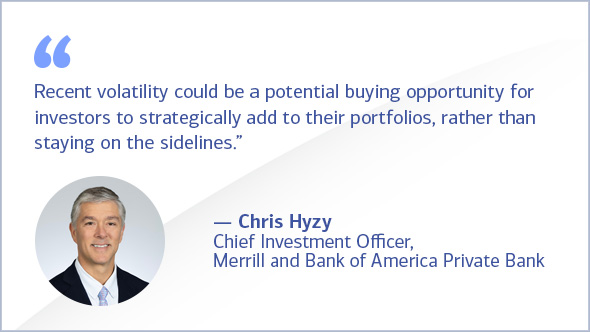 "Recent volatility could be a potential buying opportunity for investors to strategically add to their portfolios, rather than staying on the sidelines." Chris Hyzy, Chief Investment Officer, Merrill and Bank of America Private Bank
Why we expect ongoing AI growth
"Market downturn notwithstanding, AI capital expenditures continue to rise, and components remain in short supply," Hyzy says. And while heightened AI competition creates uncertainties over potential winners and losers, competition drives innovation and growth. "We believe this is a short-term disruption and a long-term benefit." The same goes for selling by over-leveraged investors. "Clearing events can help establish a more normal investment path based on corporate fundamentals over market technicals," he adds.
Tracking the risks
"Speed bumps can potentially evolve into larger slowdowns or even recessions," Hyzy says. "That typically happens later in a cycle than where we are right now, but we'll be closely watching pertinent data to assess the risks." A BofA Global Research review of semiconductor pullbacks dating from 1999 shows quick recoveries for the MSCI Global Semiconductor Index, especially when the economy avoids recession. "The average 12-month return was 44% when recession was avoided and 12% when a recession ensued," he says.Footnote 2
Investors: Avoid the noise
"While it's essential to diversify across assets and within classes, the semiconductor-related pullback is a good time to tune out the noise and stay focused on your long-term goals," Hyzy believes. "If anything, recent volatility could be a potential buying opportunity for investors to strategically add to their portfolios, rather than staying on the sidelines."
Watch for more "Ticker Tape" answers in future
Capital Market Outlook (PDF) issues, and tune in regularly to the
Market Update audiocast from the Chief Investment Office for tips, insights and updates on the economy and the markets. If you're a Merrill Edge Self-Directed investor, you can use on-line investment screeners under "Research" to help you identify Technology opportunities (
client login required).
Footnote 1 Bloomberg. Data as of July 29, 2026.
Footnote 2 BofA Global Quantitative Strategy. MSO, FactSet, Bloomberg. Data as of July 29, 2026.
August 5, 2026
Q2 earnings point to potential market opportunities
Could investors be in for a big letdown after a torrid first quarter for S&P 500 corporate earnings? Not according to Wall Street analysts, who project 20%-plus second-quarter year-over-year growthFootnote 1 as Q2 earnings roll in through late August.
"Two straight quarters of better than 20% growth is a high bar," says Lauren Sanfilippo, senior investment strategist in the Chief Investment Office (CIO) for Merrill and Bank of America Private Bank. "But U.S. companies continue to find ways to grow earnings." In a recent CIO Capital Market Outlook article, "
A high hurdle for Q2 earnings (PDF)," she examines what's behind this remarkable streak and what it might mean for investors moving forward.
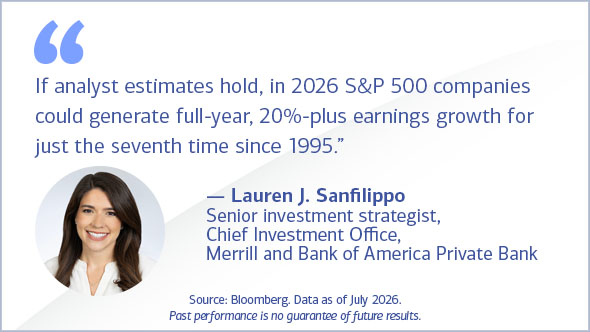 If analyst estimates hold, in 2026 S and P 500 companies could generate full-year, 20%-plus earnings growth for just the seventh time since 1995. Lauren Sanfilippo, senior investment strategist, Chief Investment Office, Merrill and Bank of America Private Bank. Source: Bloomberg. Data as of July 2026. Past performance is no guarantee of future results.
4 good reasons for investor confidence
Though past performance is no guarantee of future results, the following statistics paint a picture of broadening market participation, says Sanfilippo.
- If analyst estimates hold, in 2026 S&P 500 companies could generate full-year, 20%-plus earnings growth for just the seventh time since 1995.Footnote 2
- Even more encouraging is the breadth of industries taking part. "All but one sector are expected to report positive Q2 earnings," she says.Footnote 3
- Stock performance has similarly broadened. While the "Magnificent Seven" tech giants rose 5.5% through mid-July, the rest of the index, "the S&P 493," rose 14%.Footnote 4
- As of mid-July, more than 60% of S&P 500 stocks were trading above their 50-day moving average, and nearly 15 were up more than 100%.Footnote 5
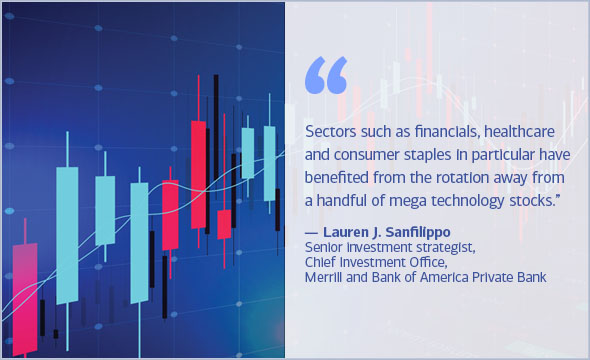 Sectors such as financials, healthcare and consumer staples in particular have benefited from the rotation away from a handful of mega technology stocks. Lauren Sanfilippo, senior investment strategist, Chief Investment Office, Merrill and Bank of America Private Bank.
Consider using the broadening market to increase diversification
"The high level of earnings growth and improving market breadth reinforces the case for portfolio diversification," Sanfilippo believes. "Sectors such as financials, healthcare and consumer staples in particular have benefited from the rotation away from a handful of mega technology stocks." Of course, conditions can change unexpectedly, but market unpredictability also argues in favor of a portfolio diversified across and within asset classes, she notes.
What's next in Q3?
Can this earnings pace continue, and what are the risks to watch out for? For ongoing insights on shifting equity market leadership, fixed income trends and portfolio strategy considerations, tune in to the CIO's
Market Update audiocast series.
Footnote 1 FactSet as of July 8, 2026.
Footnote 2 Consensus estimate for 2026. Bloomberg. Data as of July 2026.
Footnote 3 FactSet as of July 29, 2026.
Footnote 4 Morningstar, "4 charts on the not-so-magnificent seven," July 15, 2026.
Footnote 5 Bloomberg. Data as of July 8, 2026.
July 29, 2026
Fed doesn't budge on rates: What it means for you
The Federal Reserve (The Fed) on July 29 kept its federal funds rate at 3.50% to 3.75%. While rate expectations have broadly shifted from cuts to potential increases later this year, the Fed so far this year has held steady as it processes complex and sometimes mixed signals on the economy and inflation.
What's next for interest rates?
Testifying before Congress on July 14, new Fed Chair Kevin Warsh underscored the Federal Open Market Committee's commitment "to put these years of high inflation behind us."Footnote 1 With the Iran war elevating energy costs and U.S. companies and consumers showing remarkable resilience, many analysts believe the Fed will soon raise rates to keep inflation from reigniting. BofA Global Research now expects three rate increases of .25% each in 2026, starting in September.
Yet the Fed still faces a delicate balance. Lower-than-expected inflationFootnote 2 and employment figuresFootnote 3 from June offered reminders of early 2026, when a seemingly slowing economy raised expectations of a cut. "Further rate decisions will be based on the Fed's analysis of the latest information as it unfolds," says Chris Hyzy, Chief Investment Officer for Merrill and Bank of America Private Bank.
How can investors manage rate uncertainty?
"A period of higher rates, if it happens, could add income potential for bond investors, while making borrowing for large purchases more expensive," Hyzy notes. "But keep in mind that, wherever rates head next, one of the best ways to prepare is a well-diversified portfolio designed to pursue your personal goals."
Check back here for updates on interest rates and markets, and tune in regularly to the
Market Update audiocast for latest insights from the Chief Investment Office.
Footnote 1 The Federal Reserve, "Semiannual monetary policy report to the Congress," July 14, 2026.
Footnote 2 The Wall Street Journal, "Inflation slowed to 3.5% in June, as Americans got a break from gasoline prices," July 14, 2026.
Footnote 3 CBS News, "Employers added 57,000 jobs in June, far below forecasts as hiring slowed," July 2, 2026.
July 2, 2026
The United States: Most successful startup ever?
In nearly 1,400 words, The Declaration of Independence never uses the terms "business," "entrepreneur" or "capital investment." "Yet the founders in 1776 didn't just declare national sovereignty. They unleashed the greatest startup in history — the U.S. economy," says Joe Quinlan, head of Market Strategy for the Chief Investment Office (CIO) for Merrill and Bank of America Private Bank.
"Despite headline-grabbing challenges, the U.S. remains the world's biggest economic engine and most dynamic entrepreneurial culture," notes Quinlan, co-author of a recent CIO Capital Markets Outlook report, "
America at 250 (PDF)." The report examines "the entrepreneurial DNA of 1776," plus 10 reasons for optimism today. It's part history lesson, part investment guide and part birthday card to a nation sometimes preoccupied with its problems.
Legacy of innovation
To be sure, many of the issues we face today — polarization, geopolitical threats, economic inequality and rising debt — would trouble founders like George Washington, Alexander Hamilton and Ben Franklin, Quinlan believes. "But they'd be amazed and gratified to see that the American spirit of problem-solving and innovation lives on. Franklin, the original American entrepreneur, would be right at home with artificial intelligence (AI) and biotechnology," he says.
Reasons to celebrate
Well into the 21st century, the U.S. leads the way in industries as diverse as aerospace, agriculture, finance and health care. "With just 4% of the world's population, Americans generate roughly a quarter of its GDPFootnote 1," Quinlan says. What's the secret? Here are some of CIO's 10 reasons to celebrate:
- Geography as a superpower: Energy, minerals, waterways and arable land, plus oceans and allies at its borders, create a huge U.S. geographical edge from sea to shining sea.
- Technological prowess. "Despite China's astonishing progress in AIFootnote 2 and other technologies, the U.S. remains the largest market for R&D and innovation," Quinlan says.
- Creative destruction: Businesses rise and fall quickly, making way for fresh shoots of innovation, with nearly 6 million new business applications just in 2025.Footnote 3
- Foreign capital: Overseas investors remain bullish on the U.S., currently holding some $50 trillionFootnote 4 in U.S. Treasurys, corporate bonds, stocks and other assets.
Did you know?
- The U.S. is home to 9 of the top 10 global brands.Footnote 5
- 56.8% of global central bank holdings are in U.S. dollars.Footnote 6
- 26 of the world's 100 top-ranked universities are U.S.-based.Footnote 7
Investing in the next 250 years
"A dynamic, entrepreneurial economy goes hand-in-hand with solid equity returns," Quinlan says. "U.S. stocks should be a bedrock of portfolio construction, in our view." Yet creative destruction, while a strength, underscores the importance of diversifying across industries and sectors, with international equities and fixed income for balance. He adds, "Diversification and staying invested through short-term volatility could help position you for potential long-term growth as the U.S. economy embarks on the next era in its remarkable history."
Footnote 1 McKinsey & Company, "Sustaining America's competitive edge," May 6, 2026
Footnote 2 The Wall Street Journal, "China Has Matched Anthropic in Cybersecurity, Resetting AI Race," June 27, 2026
Footnote 3 Finder.com, "New business statistics: 2005 to June 2026," Jun 10, 2026
Footnote 4 U.S. Commerce Department and International Monetary Fund
Footnote 5 Kantar BrandZ, "Most Valuable Global Brands 2026," 2026
Footnote 6 Visual Capitalist, "Ranked: The World's Biggest Reserve Currencies Today," June 11, 2026
Footnote 7 QS Quacquarelli Symonds Limited, "QS World University Rankings 2026," 2026
June 17, 2026
Rates hold firm, for now, under new Fed chair
In Kevin Warsh's first meeting as Fed Chair, the Federal Reserve (the Fed) on June 17 held the federal funds rate steady at 3.50% to 3.75%. The decision dashed any hopes that a change in leadership might prompt immediate rate-cutting and signaled that inflation is at least as big a concern for the Fed right now as stimulating economic growth. Just a week earlier, May's Consumer Price Index (CPI) showed the annual inflation rate climbing above 4% for the first time in three years.Footnote 1
What's behind the Fed rate decision?
"Conditions have shifted from the start of the year, when two cuts for 2026 seemed likely," says Chris Hyzy, Chief Investment Officer for Merrill and Bank of America Private Bank. The Iran war spiked energy costs and pushed prices for other goods higher, and the U.S. economy has shown remarkable resilience, adding 172,000 jobs in May.Footnote 2 Equity markets, despite heightened volatility, continue to find new highs, and long-term bond yields have risen amid investor concerns over the Middle East and inflation.Footnote 3
When could we see a rate cut?
The administration supported Warsh as likelier than his predecessor, Jerome Powell, to push for lower rates,Footnote 4 which make borrowing easier and tend to stimulate hiring. Yet sticky inflation generally prompts the Fed to do the opposite, raising rates to slow the economy. "BofA Global Research now foresees no new rate cuts until at least mid-2027, and the chances of a .25% increase in the next year have grown," Hyzy says. "Moving forward, new economic data will be the most important factor as the Fed balances its dual mandates of full employment and stable inflation."
How can you respond to periodic volatility?
May's healthy jobs numbers, while good news for workers and the economy, helped drive a 2.6% drop in the S&P 500 index on June 5 as hopes of a rate cut diminished.Footnote 5 "Investors should expect that sort of choppiness over the next few months," Hyzy believes. "Yet the job gains, spread across healthcare, logistics, financial services, hospitality and leisure and other industries, reflect strong economic fundamentals," Hyzy adds. "Stay diversified and consider viewing short-term volatility as a potential opportunity to strategically add to your portfolio," he suggests.
For bond investors, higher yields offer the potential for meaningful income. "Instead of trying to predict exactly when interest rates and yields may change, explore adding bond duration gradually and emphasizing quality," Hyzy says. Investors concerned about inflation might consider Treasury Inflation-Protected Securities (TIPS), while high-income investors concerned about taxes may find income opportunities with tax-advantaged municipal bonds.
Check back here for updates, and tune in regularly to the
Market Update audiocast from the Chief Investment Office as interest rates and inflation data evolve.
Footnote 1 CNBC, Consumer prices rose 4.2% annually in May, highest in three years
Footnote 2 The Wall Street Journal, "May jobs growth puts U.S. on a strong hiring streak," June 5, 2026.
Footnote 3 CNBC, "Treasury yields edge higher as traders weigh rate outlook, fresh Iran tensions," June 8, 2026.
Footnote 4 CNBC, "Kevin Warsh sworn in as Fed chair as Trump seeks interest rate cuts," May 22, 2026.
Footnote 5 The New York Times, "Stocks slide as investors see rates rising after strong jobs data," June 5, 2026.
May 29, 2026
The biggest oil shock: Market resilience
Latest talks between Iran and the U.S., if they succeed, could lead to a welcome opening of the Strait of Hormuz. The shutdown has caused history's greatest oil disruption, affecting some 20% of the world's supply.Footnote 1 So, how has the world thus far avoided an economic crisis? "While higher oil prices and inflation are creating real pain for millions of consumers, several factors have helped to limit its global impact so far," says Ariana Chiu, investment strategist in the Chief Investment Office (CIO) for Merrill and Bank of America Private Bank.
Which countries are most affected by the oil disruption?
"A robust economy and energy self-sufficiency are supporting U.S. economic stability in the face of the Hormuz oil shock," Chiu says. Asia, which accepts more than 80% of the oil that moves through the Strait of Hormuz,
Footnote 2 and Europe, which sources much of its jet fuel via the passageway, are feeling the brunt, she adds. Yet the global economy has shown surprising resilience, thanks to several forces that together are mitigating about half of the disrupted supply. A recent CIO Capital Market Outlook report, "
No two oil shocks are created equal (PDF)," explores those forces as well as the risks that could lead to a wider economic crisis.
What has limited its global impact so far?
Chiu points to five key factors helping the global economy weather the oil disruption:
- A prewar "super glut." Robust 2025 production created an oil oversupply of about 3 million barrels per day at the outset of the conflict.Footnote 3
- Rerouting. While the Strait of Hormuz remains a key oil conduit, exporters have offset about 5 million barrels a day using alternative pipelines and ports,Footnote 4 Chiu says.
- Strategic reserve releases. In March, 32 Organisation for Economic Co-operation and Development (OECD) nations agreed to release 400 million barrels of strategic petroleum reserves.Footnote 5
- Lower consumption. Global oil use dropped by about 2.3 million barrels per day in April, year over year.Footnote 6 "As gas prices rise, Asian governments in particular have recommended consumers take fewer business trips, work remotely and leverage alternative forms of transportation," Chiu says.
- U.S. economic and energy resilience. As a net oil exporter, the U.S. is helping to fill the Hormuz gap, with exports rising sharply since the war started to over 6 million barrels per day.Footnote 7
Moves for investors to consider
"For now, financial markets continue to price in a relative de-escalation in the coming months. But the longer the disruption lasts, the greater the risk of a larger hit to economic growth," says Chiu. "For investors, we continue to prefer the U.S. in portfolios because of its ability to remain resilient versus other economies."
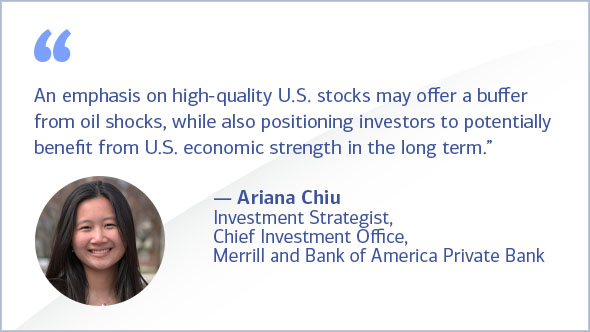
Focus on the U.S.: An emphasis on high-quality U.S. stocks may offer a buffer from oil shocks, given U.S. energy self-sufficiency, while also positioning investors to potentially benefit from U.S. economic strength, record earnings growth and artificial intelligence capital expenditures in the long term. That said, it's important to stay disciplined and diversified across and within asset classes in the face of potentially volatile headlines, Chiu adds, and to rebalance during periods of volatility.
For latest insights from the CIO on the Iranian conflict and its impacts on the economy and markets, tune in to the
Market Update audiocast.
Footnote 1 CNBC, "The U.S.-Iran war is the biggest oil disruption in history," March 9, 2026.
Footnote 2 U.S. Energy Information Administration, "Amid regional conflict, the Strait of Hormuz remains critical oil chokepoint," June 16, 2025.
Footnote 3 International Energy Agency, "Oil market report," Jan. 21, 2026.
Footnote 4 International Energy Agency, "IEA Member countries to carry out largest ever oil stock release amid market disruptions from Middle East conflict," March 11, 2026.
Footnote 5 International Energy Agency, "Oil market report," April 14, 2026.
Footnote 6 Bloomberg, "US oil exports hit record as Iran War energy crunch deepens", April 29, 2026.
Footnote 7 Bloomberg, "US oil exports hit record as Iran War energy crunch deepens", April 29, 2026.
May 13, 2026
Interest rates: Up, down or flat under new Fed chair?
Even as leadership of the Federal Reserve (the Fed) changes hands, persistent inflation may eliminate chances of hoped-for interest rate cuts through 2026. Kevin Warsh, confirmed by the full Senate on May 13, replaces Jerome Powell, whose term as chair ends on May 15. While the administration backed Warsh, a so-called interest rate dove favoring lower rates, as potentially more aggressive than his predecessor in pushing for cuts,Footnote 1 April inflation figures released yesterday show the Consumer Price Index up 3.8% from a year ago, well above the Fed's 2% target.Footnote 2
The case for current rate inaction
The latest inflation figures clearly present a challenge for the new Fed chair. Markets welcome interest rate cuts because they stimulate hiring and economic growth and make it easier for businesses and consumers to borrow money. "Yet while the labor market has softened, we haven't seen an increase in recent layoffs," says Matthew Diczok, head of Cross-Asset Market Strategy for the Chief Investment Office (CIO). "For the time being, this labor stability enables the Fed to focus on inflation pressures related to energy price spikes from the Iran conflict and tariff uncertainties, rather than unemployment."
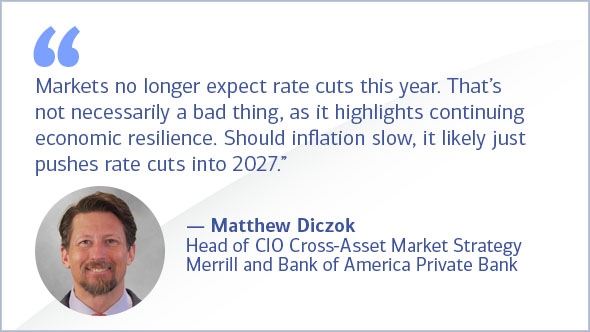
Warsh would need to rally six other Fed governors to vote for a rate cut — a difficult task as long as these conditions persist, he adds. "Markets, in fact, no longer expect rate cuts this year. That's not necessarily a bad thing, as it highlights continuing economic resilience. Should inflation slow, as expected, it likely just pushes rate cuts into 2027." BofA Global Research, which had anticipated two cuts in 2026, now believes cuts may not come until mid or late 2027. A rate hike this year is considered unlikely.
The case for future cuts in the Warsh era
While interest rate expectations are always subject to change as economic conditions evolve, rising U.S. economic productivity may allow the Fed to accommodate an extended era of somewhat elevated inflation while maintaining or lowering interest rates to spur growth. Diczok points to the early 1990s, when the Fed allowed inflation to hover around 3.3% amid a tech-related productivity boom.
Today, productivity gains from artificial intelligence (AI) and other technologies are outpacing wage growth and supporting strong equity market performance, Diczok notes. "If productivity gains continue and we are able to work through the current energy crisis and get past tariff uncertainties, that would support the Fed's ability to resume rate cuts next year."
In the meantime, he adds, "fixed income investors with excess cash could consider
longer term bonds." In fact, he says, "even short-term maturities don't look bad right now." Relative to the rest of the world, U.S. Treasurys and Treasury Inflation-Protected Securities (TIPS) offer attractive inflation-adjusted yields and fixed income.
For latest insights on the markets, economy and where interest rates might go next, tune in regularly to the CIO's
Market Update audiocast.
Footnote 1 The Guardian, "US Senate expected to confirm Kevin Warsh as next Federal Reserve chair," May 11, 2026
Footnote 2 The Wall Street Journal, "Inflation soared to 3.8% in April, driven by gasoline prices," May 12, 2026.
Share:
Important Disclosures
Investing involves risk, including the possible loss of principal. Past performance is no guarantee of future results.
Opinions are as of the date of these articles and are subject to change.
Bank of America, Merrill, their affiliates, and advisors do not provide legal, tax, or accounting advice. Clients should consult their legal and/or tax advisors before making any financial decisions.
This information should not be construed as investment advice and is subject to change. It is provided for informational purposes only and is not intended to be either a specific offer by Bank of America, Merrill or any affiliate to sell or provide, or a specific invitation for a consumer to apply for, any particular retail financial product or service that may be available.
The Chief Investment Office (CIO) provides thought leadership on wealth management, investment strategy and global markets; portfolio management solutions; due diligence; and solutions oversight and data analytics. CIO viewpoints are developed for Bank of America Private Bank, a division of Bank of America, N.A., ("Bank of America") and Merrill Lynch, Pierce, Fenner & Smith Incorporated ("MLPF&S" or "Merrill"), a registered broker-dealer, registered investment adviser and a wholly owned subsidiary of Bank of America Corporation ("BofA Corp.").
BofA Global Research is research produced by BofA Securities, Inc. ("BofAS") and/or one or more of its affiliates. BofAS is a registered broker-dealer, Member SIPC, and wholly owned subsidiary of Bank of America Corporation.
All recommendations must be considered in the context of an individual investor's goals, time horizon, liquidity needs and risk tolerance. Not all recommendations will be in the best interest of all investors.
Investments have varying degrees of risk. Some of the risks involved with equity securities include the possibility that the value of the stocks may fluctuate in response to events specific to the companies or markets, as well as economic, political or social events in the U.S. or abroad. Bonds are subject to interest rate, inflation and credit risks. Treasury bills are less volatile than longer-term fixed income securities and are guaranteed as to timely payment of principal and interest by the U.S. government. Investments in a certain industry or sector may pose additional risk due to lack of diversification and sector concentration.
Investments in foreign securities involve special risks, including foreign currency risk and the possibility of substantial volatility due to adverse political, economic or other developments. These risks are magnified for investments made in emerging markets. There are special risks associated with an investment in commodities, including market price fluctuations, regulatory changes, interest rate changes, credit risk, economic changes and the impact of adverse political or financial factors.
Income from investing in municipal bonds is generally exempt from Federal and state taxes for residents of the issuing state. While the interest income is tax-exempt, any capital gains distributed are taxable to the investor. Income for some investors may be subject to the Federal Alternative Minimum Tax (AMT).
Retirement and Personal Wealth Solutions is the institutional retirement business of Bank of America Corporation ("BofA Corp.") operating under the name "Bank of America." Investment advisory and brokerage services are provided by wholly owned non-bank affiliates of BofA Corp., including Merrill Lynch, Pierce, Fenner & Smith Incorporated (also referred to as "MLPF&S" or "Merrill"), a dually registered broker-dealer and investment adviser and Member SIPC. Banking activities may be performed by wholly owned banking affiliates of BofA Corp., including Bank of America, N.A., Member FDIC.
You have choices about what to do with your 401(k) or other type of plan-sponsored accounts. Depending on your financial circumstances, needs and goals, you may choose to roll over to an IRA or convert to a Roth IRA, roll over a 401(k) from a prior employer to a 401(k) at your new employer, take a distribution, or leave the account where it is. Each choice may offer different investments and services, fees and expenses, withdrawal options, required minimum distributions, tax treatment (particularly with reference to employer stock), and provide different protection from creditors and legal judgments. These are complex choices and should be considered with care.
Diversification does not ensure a profit or protect against loss in declining markets.
Investing in Gold involves special risks, including market price fluctuations, regulatory changes, interest rate changes, credit risk, economic changes, and the impact of adverse political or financial factors.
Equity securities are subject to stock market fluctuations that occur in response to economic and business developments. Stocks of small- and mid-cap companies pose special risks, including possible illiquidity and greater price volatility than stocks of larger, more established companies. Investments focused in a certain industry or sector may pose additional risks due to lack of diversification, industry volatility, economic turmoil, susceptibility to economic, political or regulatory risks and other sector concentration risks.
MAP9115948-03092028